AI Education and the Student's Future
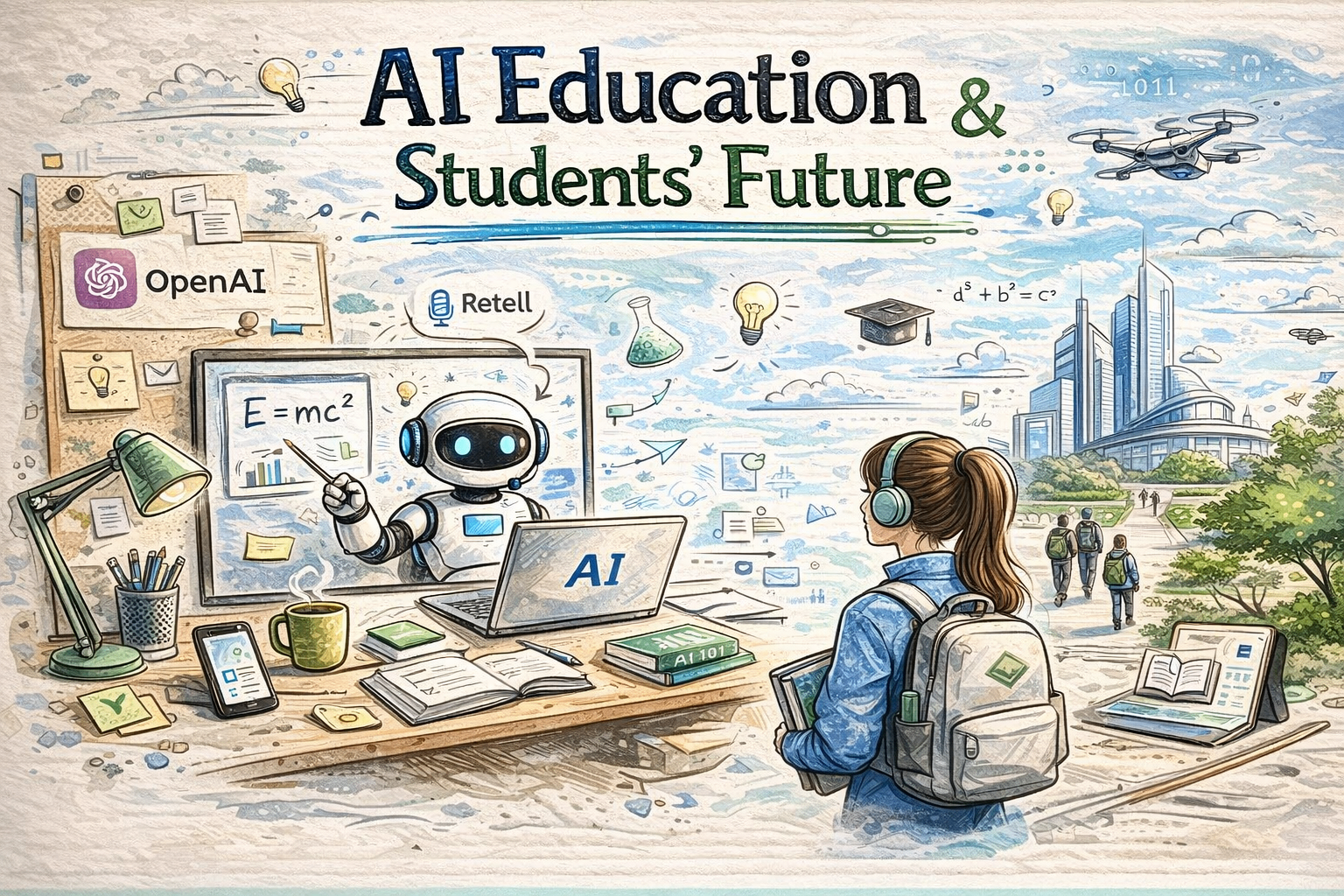
There was a time when education followed a predictable path. You learned information, memorized it, reproduced it in exams, and hoped it would be enough to prepare you for the real world. That model worked — at least for a while. But as we move deeper into an AI-driven era, the foundation of that system is beginning to crack. Not because education is losing its value, but because the nature of value itself is changing.
Artificial Intelligence is not just another subject to be added to a curriculum. It is a force that is reshaping how knowledge is accessed, how problems are solved, and ultimately, how work is done. For students, this shift is not theoretical. It is immediate, and it is personal. The question is no longer whether they will use AI in the future. The question is whether they will understand how to use it effectively — or be outpaced by those who do.
The collapse of information scarcity
One of the most significant changes AI brings is the collapse of information scarcity. Students today no longer struggle to find answers; they struggle to navigate an overwhelming abundance of them. A concept that once required hours of searching through textbooks can now be explained in seconds. Homework, research, even creative writing — AI can assist with all of it. On the surface, this seems like an advantage. But it introduces a deeper challenge. When answers are easily available, the true differentiator becomes the ability to ask better questions.
This is where the role of education must evolve. It is no longer enough to teach students what to think. They must be taught how to think — how to break down problems, evaluate outputs, and guide AI toward meaningful results. The skill is not in using the tool, but in directing it. A student who can do this effectively gains a significant edge, not because they know more, but because they can do more with what they know.
From learners to builders
At the same time, there is a growing need to move beyond passive consumption and toward active creation. AI has made it possible for students to build, experiment, and execute ideas at a level that was previously inaccessible. A student can now design a website, automate a workflow, or create a functional product without years of technical training. This shift transforms students from learners into builders. It gives them the ability to test ideas in real environments, to fail quickly, and to improve just as fast.
However, this new capability comes with responsibility. AI can generate answers, but it cannot replace judgment. It can suggest solutions, but it cannot fully understand context. Students who rely on it blindly risk becoming dependent rather than empowered. This is why critical thinking becomes more important, not less. The ability to question outputs, to refine prompts, and to recognize limitations is what separates meaningful use from superficial reliance.
The rise of the generalist
Another dimension that cannot be ignored is the changing definition of skills. Traditional education has long emphasized specialization — becoming deeply skilled in one area. While this still holds value, the rise of AI is creating space for a different kind of thinker: the generalist. A student who understands how to connect ideas across domains, who can integrate tools into systems, and who can adapt quickly to new technologies is becoming increasingly valuable. This does not mean depth is irrelevant. It means flexibility is now just as important as expertise.
There is also a shift happening in how students prepare for the workforce. The jobs they are training for today may not exist in the same form tomorrow. Roles are evolving, merging, and in some cases, disappearing altogether. But this is not necessarily a negative development. It opens up new opportunities — roles that combine creativity, technology, and problem-solving in ways that were previously unimaginable. The challenge lies in preparing students not for specific jobs, but for a landscape that is constantly changing.
Education must embrace adaptability
In this context, education must move beyond rigid structures and embrace adaptability. It must create environments where students are encouraged to experiment, to build, and to think independently. Exposure to AI should not be limited to theory. It should be integrated into practical experiences — projects, simulations, and real-world applications that allow students to understand its potential and its limitations.
Perhaps the most important shift, however, is in mindset. Students need to see AI not as a threat, but as a tool — one that can amplify their abilities if used correctly. Fear often comes from misunderstanding. When students are given the opportunity to engage with AI directly, to explore its capabilities, and to learn its boundaries, that fear is replaced with curiosity and confidence.
From recipients to participants
The future of education is not about competing with AI. It is about learning how to work alongside it. Students who develop this understanding early will not just adapt to change — they will drive it. They will be the ones who build new systems, create new opportunities, and redefine what is possible.
In the end, the role of AI in education is not to replace learning, but to transform it. It challenges long-standing assumptions, forces a rethinking of priorities, and opens doors to new ways of thinking and creating. For students, this is not just a shift in tools. It is a shift in identity — from passive recipients of knowledge to active participants in shaping the future.
And in a world where change is the only constant, that may be the most valuable education of all.