AI in 2026: What Actually Works and What Doesn't
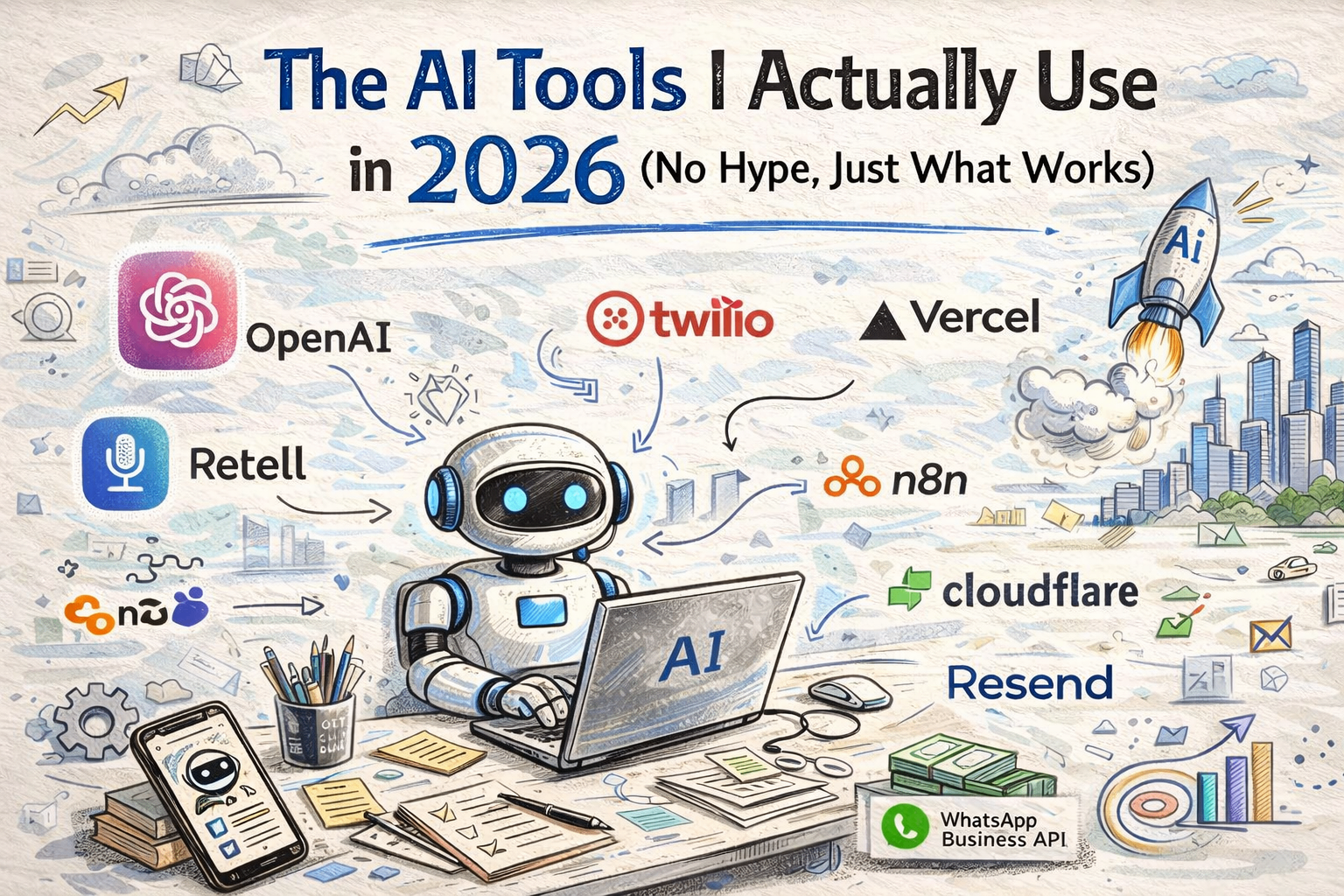
There is no shortage of AI tools in 2026. In fact, that's the problem. Every week, something new launches, promises to change everything, and disappears just as quickly. It's easy to get caught in the loop of trying everything and committing to nothing. Over time, I've learned that the real advantage doesn't come from knowing more tools — it comes from using fewer tools, properly.
What I use today is not based on hype. It's based on what actually holds up under real business pressure — handling customers, automating workflows, and producing outcomes that matter. This is not a "perfect" stack. It's a working one. And that distinction is everything.
The thinking layer: OpenAI
At the core of everything I build sits OpenAI. Not because it's trendy, but because it's reliable and adaptable. Whether it's powering conversational systems, generating structured outputs, or handling decision logic inside workflows, it consistently delivers where it matters. I don't use it in isolation. I use it as a thinking layer that sits inside larger systems, guiding interactions and making decisions dynamically. The real value is not in the model itself, but in how it is embedded into a process.
Voice: Retell + Twilio
For voice, the shift over the past year has been significant. Text-based systems are no longer enough for most real-world applications. I rely on platforms like Retell to build AI voice agents that can handle actual conversations, not just scripted responses. Combined with telephony infrastructure like Twilio, this allows businesses to automate inbound and outbound communication without compromising on experience. In markets like the GCC, where language flexibility is critical, this combination becomes even more powerful. It's no longer about "having a voice bot." It's about replacing missed opportunities with consistent engagement.
Automation: n8n
Automation is where everything comes together, and for that, tools like n8n have become central to how I operate. I prefer it over more rigid platforms because it gives me control. Every workflow — whether it's lead capture, follow-ups, notifications, or data syncing — can be designed exactly the way the business needs it to function. This is where AI stops being a feature and becomes part of a system. A well-designed workflow doesn't just automate tasks; it removes the need for manual intervention altogether.
Infrastructure: Vercel, Supabase, Cloudflare
On the infrastructure side, I keep things intentionally simple. Vercel handles deployment, allowing me to push updates quickly without dealing with unnecessary overhead. Supabase takes care of databases and authentication, providing a clean and efficient backend without slowing down development. For domains and performance optimization, Cloudflare does its job quietly in the background. None of these tools are exciting on their own, but together they create a foundation that is fast, stable, and easy to scale.
Communication: WhatsApp + Resend
Communication layers are just as important as the backend. WhatsApp, in particular, has become a critical channel for business interaction, especially in regions like Kuwait and the UAE. Integrating the WhatsApp Business API into workflows allows for instant engagement, automated responses, and continuous follow-ups without relying on human availability. When combined with AI, it turns into a powerful conversion engine rather than just a messaging platform.
For email systems, I rely on services like Resend. It's straightforward, reliable, and does exactly what it's supposed to do without unnecessary complexity. Whether it's sending alerts, reports, or automated sequences, it fits seamlessly into the broader system without becoming a bottleneck.
The principle: nothing without purpose
One thing I've consciously avoided is overengineering. There is a tendency, especially in AI, to build layers upon layers of complexity in the name of sophistication. In practice, this usually leads to fragile systems that are difficult to maintain and even harder to scale. The stack I use is deliberately lean. Every tool has a purpose. If it doesn't directly contribute to solving a problem or improving an outcome, it doesn't belong.
Another important shift in 2026 is how these tools are used together. Individually, they are powerful. But the real value emerges when they are connected into a cohesive system. An AI model responding to a query is useful. An AI model that captures that query, qualifies it, updates a CRM, triggers a follow-up, and books an appointment without human input — that is where things start to change. The focus is no longer on tools, but on how they interact.
There is also a level of maturity that comes with experience. Early on, it's tempting to chase the newest releases, experiment constantly, and rebuild systems from scratch just to try something different. Over time, you realize that stability is more valuable than novelty. A tool that works consistently will always outperform one that is theoretically better but unreliable in practice.
If there is one principle that defines my stack, it is this: everything must justify its existence. Every tool, every integration, every workflow has to earn its place by contributing to a clear outcome. There is no room for redundancy, and no tolerance for unnecessary complexity.
In the end, building with AI in 2026 is not about having access to the best tools. Everyone has access to the same tools. The difference lies in how they are used. A well-structured system built on a simple, reliable stack will outperform a complex setup filled with cutting-edge tools that don't integrate well.
The stack will continue to evolve. Tools will change, platforms will rise and fall. But the approach remains constant. Keep it simple. Build for outcomes. And use only what actually works.