AI Strategy for Leaders Who Actually Ship
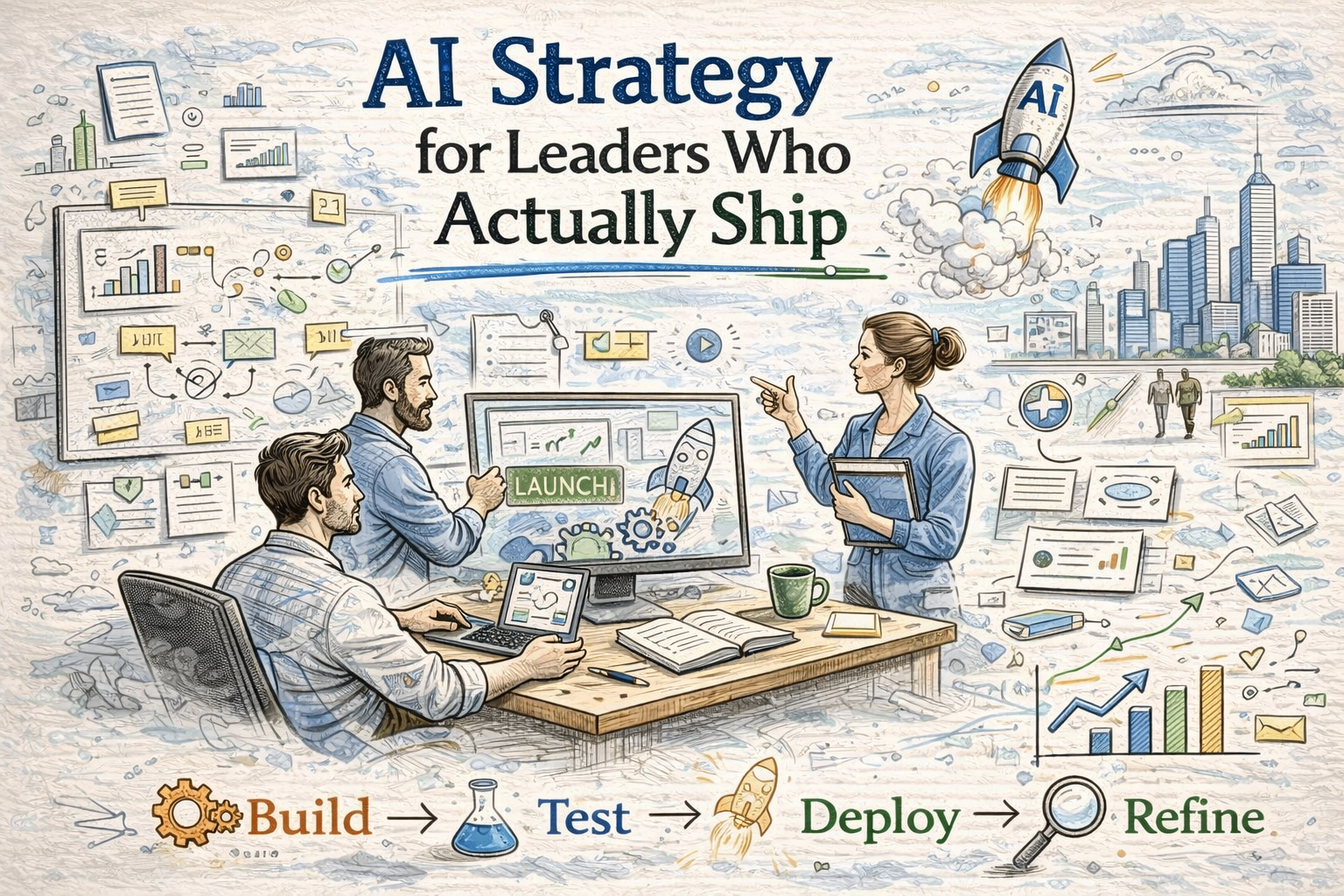
There is a growing divide in how organizations approach artificial intelligence. On one side are the companies that talk endlessly about strategy — frameworks, roadmaps, and transformation plans that look impressive in presentations but rarely translate into real-world impact. On the other side are a smaller group of leaders who take a very different approach. They do not wait for perfect clarity. They build, test, and deploy. They ship.
The difference between these two groups is not intelligence, resources, or even ambition. It is execution.
In 2026, AI strategy is no longer about understanding what is possible. That phase is over. The tools are accessible, the capabilities are proven, and the barriers to entry are lower than they have ever been. The real challenge now lies in turning that potential into something tangible — something that works inside the business, interacts with customers, and produces measurable outcomes.
Start with friction, not frameworks
Leaders who succeed in this environment begin by shifting their focus away from abstract ideas and toward operational friction. They do not ask, "How can we use AI?" They ask, "Where are we losing time, money, or opportunities right now?" This question changes everything. It grounds the conversation in reality and forces the organization to confront inefficiencies that have often been accepted as normal.
Once that friction is identified, the next step is not to design a comprehensive solution. It is to define a single, clear outcome. This is where discipline becomes critical. There is always a temptation to expand the scope — to build a system that handles multiple functions, integrates across departments, and solves problems that have not yet been fully understood. Leaders who actually ship resist this urge. They narrow their focus. They choose one outcome and commit to delivering it effectively.
This approach may appear limited at first, but it creates momentum. A system that reliably solves one problem provides immediate value. It also creates a foundation that can be expanded over time, based on real insights rather than assumptions. In contrast, broad strategies often collapse under their own complexity, never reaching a point where they deliver anything meaningful.
Speed is a strategy
Speed plays an equally important role in this process. The organizations that are making progress are not the ones with the most sophisticated plans. They are the ones that move quickly from idea to implementation. This does not mean rushing blindly. It means prioritizing progress over perfection. A working system that can be tested and improved is far more valuable than a theoretical model that remains confined to a slide deck.
Testing in real environments is where strategy meets reality. It is also where many initiatives fail. Controlled testing conditions can create a false sense of confidence, masking issues that only become visible when the system interacts with actual users. Leaders who ship understand this. They expose their systems to real-world conditions early, even when it is uncomfortable. They accept that mistakes will happen, because those mistakes provide the feedback needed to refine the system.
Filter feedback, protect the outcome
This leads to another important distinction. Not all feedback is equal. In the early stages, there will be countless suggestions — features to add, improvements to make, ideas to explore. The challenge is not in collecting feedback, but in filtering it. Leaders who maintain focus evaluate every suggestion against a simple question: does this improve the core outcome? If the answer is no, it is set aside. This level of discipline prevents the system from becoming diluted and ensures that progress remains aligned with the original objective.
Scale simplicity, not complexity
As systems begin to prove their value, the conversation naturally shifts toward scale. This is where many organizations make another critical mistake. They attempt to scale complexity instead of scaling simplicity. They add layers, tools, and integrations without fully understanding how they interact. Over time, this creates systems that are difficult to manage and even harder to adapt.
Leaders who approach scaling effectively take a different path. They standardize what works. They refine processes, simplify workflows, and create repeatable structures that can be applied across different parts of the organization. The goal is not to build something more complicated. It is to build something more consistent.
Action over analysis
Underlying all of this is a mindset that prioritizes action over analysis. This does not mean abandoning strategic thinking. It means recognizing that strategy without execution has no value. In an environment where tools evolve rapidly and opportunities emerge quickly, the ability to act becomes a competitive advantage.
There is also a cultural element that cannot be ignored. Organizations that successfully implement AI are not just changing their technology; they are changing how their teams think and operate. They encourage experimentation, accept iteration, and create space for learning through doing. This culture does not eliminate risk, but it makes risk manageable by turning it into a source of insight rather than a barrier to progress.
Perhaps the most important realization for leaders in 2026 is that AI strategy is not a one-time initiative. It is an ongoing process of identifying opportunities, building solutions, and refining them based on real-world performance. It requires adaptability, not rigid planning. It demands clarity, not complexity.
The leaders who ship
In the end, the distinction between those who talk about AI and those who benefit from it is straightforward. One group treats it as a concept to be explored. The other treats it as a tool to be applied.
The leaders who ship are not necessarily the ones with the most knowledge. They are the ones who move, who test, and who deliver. And in a landscape defined by constant change, that ability to act is what separates progress from stagnation.