How I Build AI Products From Zero to Launch
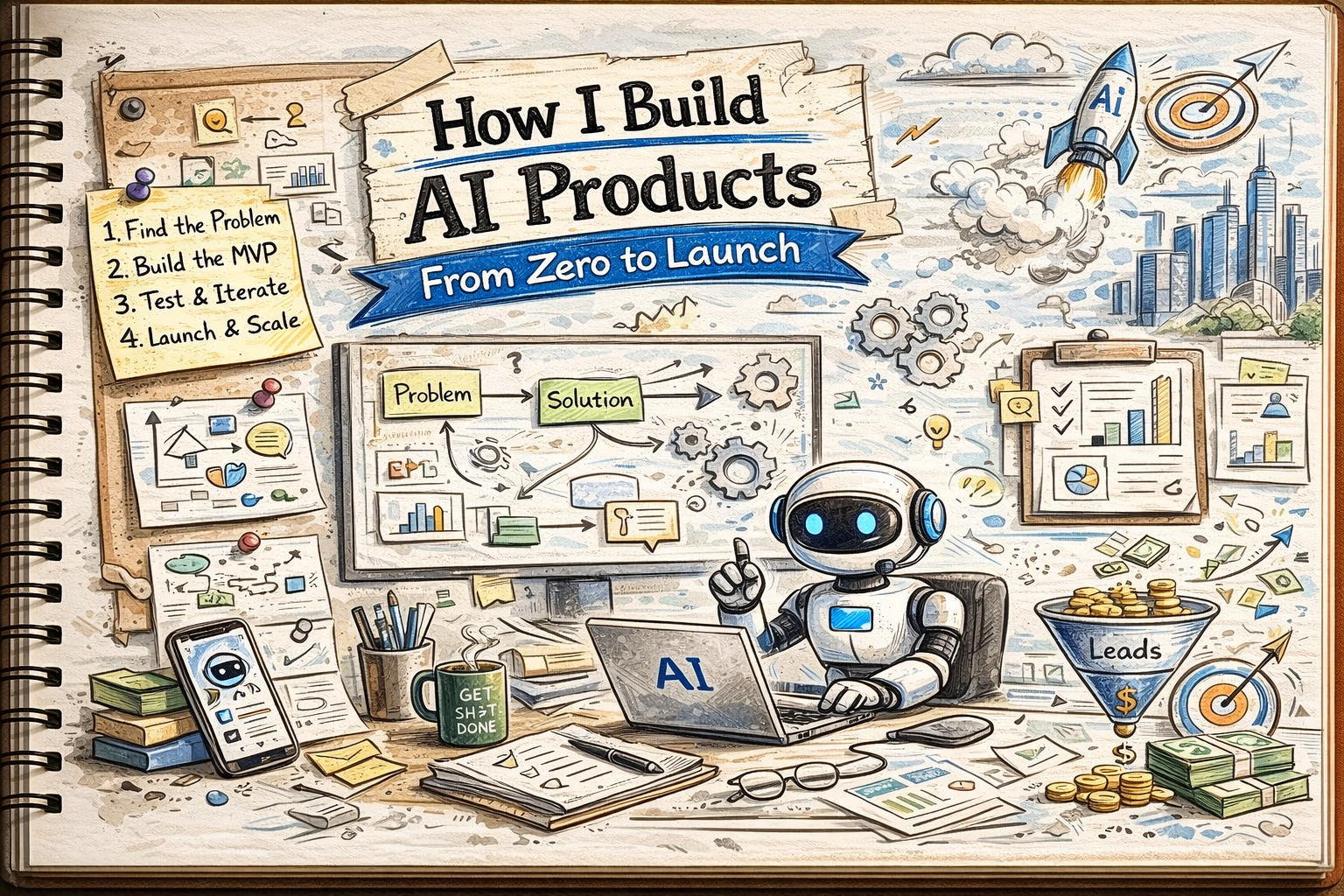
There is a common misconception that building an AI product begins with a clever idea or access to advanced technology. In reality, neither of those things matter as much as people think. What actually matters is far simpler, and far more grounded: a problem that is already costing someone time, money, or opportunity. Without that, everything else is just decoration.
Start with friction, not technology
Whenever I begin working on a new AI product, I deliberately ignore the technology at first. I don't think about models, APIs, or architecture. Instead, I focus entirely on identifying friction within a business. It could be missed calls that never convert into customers, slow responses that drive prospects away, or repetitive manual tasks that drain time and energy. These are not glamorous problems, but they are real, and more importantly, they are measurable. If I cannot clearly identify where a business is "bleeding," I know immediately that the product has no real foundation. It may look impressive, but it will struggle to sell, and even more so to sustain itself.
One outcome, ruthlessly defended
Once the problem is clear, the next step is to resist the urge to build everything at once. This is where most projects collapse under their own ambition. There is always a temptation to add features — dashboards, analytics, integrations, automation layers — all in the name of creating something "complete." I take the opposite approach. I define a single outcome that the product must achieve, and I focus on that outcome with complete discipline. It might be something as straightforward as answering every incoming call automatically, or converting website visitors into booked appointments. The simplicity is intentional. A product that does one thing exceptionally well is far more valuable than one that attempts to do ten things poorly.
Build the simplest thing that works
With that clarity in place, I move quickly to build the simplest version that actually works. Perfection is not the goal at this stage — functionality is. I rely heavily on existing tools and infrastructure, stitching together APIs and workflows to get a working system in place as fast as possible. The interface is often minimal, sometimes even nonexistent in the early stages. What matters is whether the system can interact with real users and produce a tangible result. If it takes too long to reach this point, it usually means the process has become unnecessarily complicated.
Test in the wild, not in a lab
The moment a working version exists, it goes into a real environment. This is not optional. Testing in isolation creates a false sense of confidence, because controlled conditions rarely reflect how people actually behave. Once the product is exposed to real users — real conversations, real expectations, real unpredictability — the gaps become immediately visible. You start to see where the system breaks, where it misunderstands intent, and where it fails to deliver the expected outcome. This stage is often uncomfortable, but it is also where the most valuable insights emerge.
Refine only what moves the outcome
From there, the process becomes one of focused refinement. Instead of chasing improvements that look impressive on the surface, I concentrate only on what directly impacts the core outcome. If the goal is to book appointments, then everything I adjust revolves around accuracy, response speed, and conversation flow. Features that do not contribute to that outcome are deliberately ignored, no matter how appealing they may seem. This discipline is what keeps the product aligned with its purpose.
Only after the system has proven that it works do I begin to add structure around it. This is when dashboards, analytics, and integrations start to take shape. By this point, these elements are no longer speculative — they are informed by real usage and real needs. Building them earlier would have been guesswork. Building them now makes them purposeful.
From solution to product
The next transition is subtle but important. A working solution for one use case is not yet a product. To reach that stage, it must become repeatable. This involves standardizing the workflows, refining prompts, and creating a deployment process that can be applied across different clients or industries without starting from scratch each time. It is at this point that the system begins to scale, not because it is more complex, but because it is more consistent.
Sell before it feels finished
One of the more uncomfortable truths in this process is that I do not wait for the product to feel "complete" before putting it in front of paying customers. If it delivers value, it is ready to be sold. In fact, selling early often accelerates improvement, because real customers provide feedback that is far more direct and far more useful than internal testing ever could. Waiting for perfection is rarely a strategic decision — it is usually hesitation in disguise.
Protect simplicity as you scale
As the product grows, the challenge shifts. It is no longer about getting something to work, but about keeping it simple as it evolves. There is a constant pull toward adding more features, more layers, more complexity. Left unchecked, this can quickly turn a focused system into something bloated and difficult to maintain. I make a conscious effort to resist that pull. The most effective AI products are not the ones with the most capabilities, but the ones that remain reliable, clear in purpose, and easy to use.
At its core, building AI products is not about mastering every new tool or chasing the latest advancements. Those will continue to change. What remains consistent is the approach: understanding real problems, moving quickly to create working solutions, testing them in real conditions, and refining them based on actual outcomes. It is a process grounded in practicality rather than theory.
In the end, the distinction is simple. There are products built to demonstrate what AI can do, and there are products built to deliver results. The former may attract attention, but the latter create value. And in a landscape that is becoming increasingly crowded, value is the only thing that truly lasts.