The Future of AI: What 2026 Really Looks Like
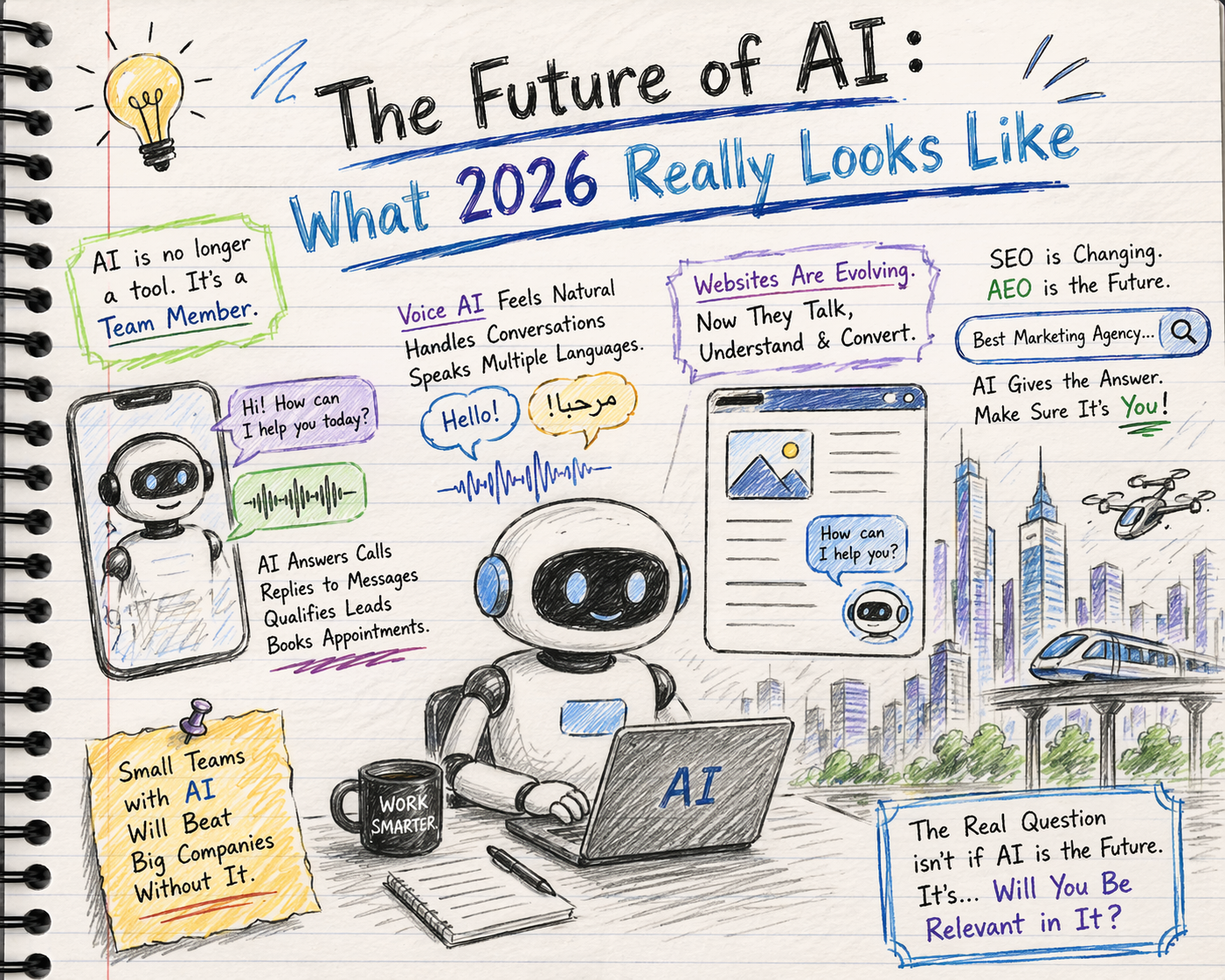
For the past few years, the conversation around AI has been loud, dramatic, and often exaggerated. Headlines have promised revolutions, disruptions, and the complete rewriting of how the world works. But step into 2026, and the reality is far more grounded — and far more powerful.
AI hasn't arrived as a sudden shock to the system. It has quietly settled into the background, embedding itself into the way businesses operate, communicate, and grow. The biggest shift is not that AI is everywhere. It's that you no longer notice it. Much like electricity or the internet, it has become part of the infrastructure. You don't "use AI" anymore. You simply run your business, and AI runs with you.
One of the clearest transformations is in how businesses interact with customers. What used to be a manual, human-first process has now evolved into a system-driven approach. AI is no longer a tool you open when needed; it has become a constant presence. It answers calls, responds to messages, qualifies leads, and schedules appointments without waiting for human intervention. This isn't innovation anymore — it's operations. And the businesses that still rely on delayed responses and manual follow-ups are beginning to feel noticeably slow in comparison.
Voice becomes the default interface
Voice, in particular, has emerged as a defining layer of this shift. While earlier years focused heavily on text-based AI, 2026 has moved decisively into conversational systems. Customers no longer want to fill out forms or wait for replies. They want to speak, and they expect immediate, intelligent responses. AI voice agents now handle full conversations with a level of fluency that feels natural, often switching between languages seamlessly. In regions like the GCC, where bilingual communication is essential, this capability is not just impressive — it's a competitive advantage. Businesses that adopt it are creating faster, smoother customer experiences, while others are left trying to catch up.
The quiet death of the website
At the same time, the concept of a "website" has undergone a quiet but significant death. The static, brochure-style website that once defined a business's online presence no longer serves a meaningful purpose. In its place, a new model has taken over: the AI-powered sales system. A modern digital presence doesn't just display information; it engages, guides, and converts. Visitors are no longer left to navigate pages on their own. They are met with intelligent systems that understand intent, ask the right questions, and move them toward action — whether that means starting a conversation, booking a service, or making a purchase. If a website is not actively generating leads and driving decisions, it has become little more than decoration.
From SEO to AEO
This shift is closely tied to another change that many are still underestimating: the evolution of search. Traditional SEO, built around ranking pages and driving clicks, is steadily giving way to a new paradigm. People are no longer searching in the same way. Instead of browsing through multiple links, they are asking AI systems directly and receiving a single, curated answer. This has given rise to what is now being recognized as AEO — Answer Engine Optimization. In 2026, visibility is no longer about being listed. It is about being chosen as the answer. Businesses that fail to structure their presence for this new layer of discovery risk becoming invisible, regardless of how strong their offerings may be.
The rise of the AI Generalist
Amid all of this, a new kind of professional has begun to stand out — the AI Generalist. This is not someone defined by deep expertise in a single domain, but by their ability to connect systems, automate processes, and think beyond individual tasks. They understand how tools interact, how workflows can be optimized, and how outcomes can be achieved with minimal manual effort. In many ways, this mindset has become more valuable than technical specialization alone. The ability to design systems that perform the work is now more powerful than doing the work itself.
This is also why smaller teams are beginning to outperform larger organizations in surprising ways. With AI handling repetitive tasks, communication bottlenecks, and operational inefficiencies, a lean team equipped with the right systems can move faster and execute more effectively than a much larger workforce. The traditional advantages of scale are being challenged, not by more resources, but by smarter use of technology.
The widening gap
However, this transformation comes with a reality that cannot be ignored. The gap between those who adapt and those who do not is widening rapidly. AI is no longer a space for casual interest or optional learning. It has become a fundamental layer of how work gets done. There are those who use it to amplify their capabilities, and those who continue to operate without it. The difference between the two is not subtle — it is exponential.
What matters now is not mastering every tool or chasing every new development. It is about taking deliberate steps. Automating a single process. Replacing one repetitive task. Introducing one system that reduces dependency on manual effort. These small shifts compound quickly, and over time, they redefine how a business operates.
The future of AI is not something distant or abstract. It is already here, woven into the systems that are quietly reshaping industries. The real question is no longer whether AI will change the way we work. That has already happened.
The question that remains is far more personal and far more immediate: will you evolve with it, or will you be left competing against those who did?